Introduction
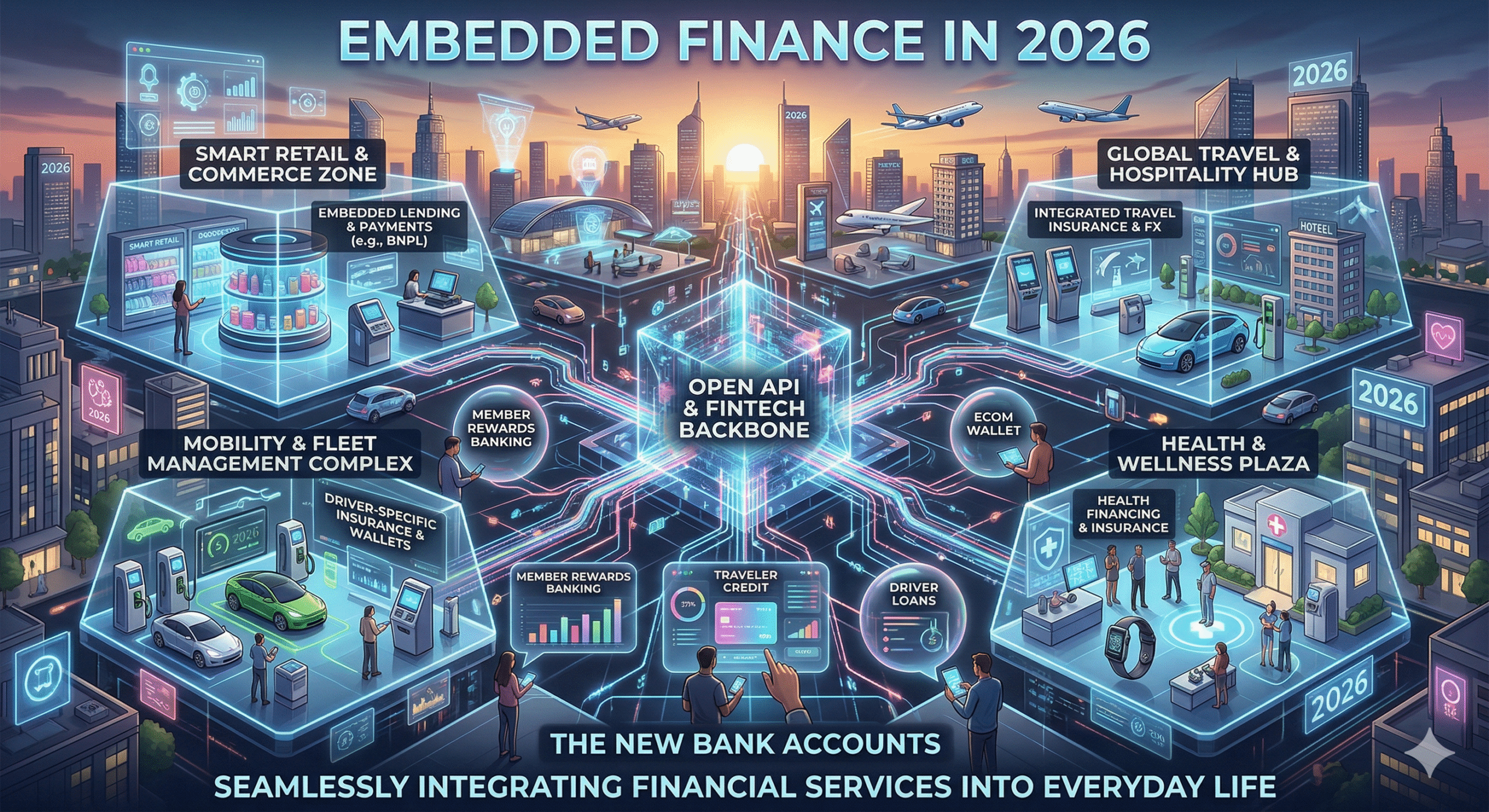
When a customer using a logistics app takes out a working capital loan to cover a shipment. When a freelancer on a gig platform receives instant earnings payouts the moment a job is marked complete. When a retail checkout adds insurance to a purchase in a single tap. When an e-commerce merchant gets a revenue-based credit line automatically sized to their sales history – without filling out a bank form or waiting five days.None of these involve a bank. None involve visiting a financial services platform. All of them are embedded finance – financial products delivered seamlessly inside non-financial applications, at the exact moment the customer needs them.In 2026, embedded finance is no longer a fintech buzzword. It is a market transformation. Embedded finance transactions are projected to surpass $7 trillion this year, accounting for over 10% of all US financial flows. The companies building this infrastructure – and the non-financial platforms embedding it into their products – are capturing a revenue stream that traditional banks spent decades building, at a fraction of the time and capital cost.This guide is written for fintech founders, product managers, and technical leaders who want the full picture: what embedded finance actually is, which verticals are winning in 2026, what the technical architecture looks like, how agentic AI is reshaping financial transactions, and what it takes to build or integrate embedded financial products in the current environment.
What Is Embedded Finance? The Precise Definition
Embedded finance is the integration of financial services – payments, lending, insurance, investment, banking – directly into non-financial software platforms and customer experiences. The defining characteristic is that the financial product is accessed within the context of a non-financial activity, not by visiting a separate financial service. The concept is not entirely new. Store credit cards and layaway plans were early, clunky versions of embedded lending. PayPal embedded payments into e-commerce in the early 2000s. What has changed is the infrastructure: the API-first banking layer (Banking-as-a-Service, or BaaS), the regulatory frameworks that permit non-banks to offer financial products, and the data availability that makes real-time credit and risk decisions possible.The result in 2026 is a world where embedding a payment, a loan, an insurance product, or a savings account into your platform does not require a banking licence, a compliance team of twenty, or a decade of regulatory work. It requires good API integration, the right BaaS partner, and product design that puts the financial experience in the right context at the right moment in the customer journey.
The Five Pillars of Embedded Finance in 2026
Embedded finance is not a single product category. It is a family of financial services, each with its own technical requirements, regulatory considerations, and business model dynamics. Here is the state of each pillar in 2026.
1. Embedded Payments
The most mature and most widely deployed category. Embedded payments allow platforms to accept, hold, split, and disburse money without the customer ever leaving the platform experience. The evolution in 2026 goes well beyond simple checkout integration. Agentic commerce has arrived. Visa’s Trusted Agent Protocol, already live and backed by Microsoft, Stripe, Nuvei, and Worldpay, enables verified AI agents to signal purchase intent, identify the consumer behind the session, and transmit payment credentials autonomously – processing transactions that happen without a human ever clicking buy. Mastercard has launched parallel infrastructure. The payments industry is racing to accommodate a world where AI agents are significant transacting parties, not just tools used by human buyers. For product builders, the practical implication is clear: payment architectures built in 2026 need to be designed for both human and agent transactions. Token-based authentication, programmatic consent management, and real-time fraud systems that can distinguish between legitimate automated transactions and malicious bot activity are no longer optional architecture considerations – they are baseline requirements.
2. Embedded Lending
Embedded lending is the fastest-growing category in embedded finance in 2026, and it is reshaping how businesses and consumers access credit. Instead of applying for a loan at a bank, borrowers receive credit offers at the moment they need capital – inside the platform they already use. The most powerful form is data-native lending: credit decisions made in real time using the platform’s own data about the borrower. A logistics platform that knows a driver’s income history, route reliability, and on-time delivery rate can price a working capital loan far more accurately than a bank using a credit bureau score. An e-commerce platform that knows a merchant’s revenue trajectory, return rate, and customer repeat rate can offer revenue-based financing that a traditional lender cannot. This data advantage is the core of why embedded lending can undercut traditional bank lending on both price and speed while maintaining or improving credit performance. The platform knows things the bank does not – and with the right AI underwriting model, that contextual knowledge translates directly into better credit decisions.
3. Embedded Insurance
Embedded insurance is the practice of offering insurance coverage at the point of a relevant transaction or activity – eliminating the historically friction-filled process of purchasing insurance separately. The customer is already in context. The risk being insured is already understood. The premium can be calculated in real time and added to an existing transaction. The categories seeing the most traction in 2026 are: device protection offered at point of purchase, travel insurance offered at flight or hotel booking, cargo and logistics insurance offered at shipment creation, and income protection offered through gig and freelance platforms. In each case, the insurance is contextual, instant, and priced using platform-native data that traditional insurers lack access to.
4. Embedded Banking and Accounts
Embedded banking goes beyond transactions to give platforms the ability to offer their users a full account experience – balances, statements, cards, and money management tools – without those users needing a relationship with a traditional bank. The most compelling implementations in 2026 are in gig economy and creator platforms. Workers on delivery platforms, freelance marketplaces, and creator economy tools increasingly have their primary financial relationship with the platform, not a bank. Instant access to earnings, expense cards, tax withholding automation, and savings features built into the platform create a stickiness and loyalty that no traditional bank can match – because no bank has the contextual data or the customer interaction frequency that these platforms do.
5. Open Finance and the API Layer
Open finance is the infrastructure layer that makes all of the above possible at scale. Where open banking was about sharing bank account data through APIs, open finance in 2026 extends to the full financial picture: pensions, insurance, mortgages, payroll, tax data, and crypto wallets – all flowing through a unified, consent-based API layer that gives consumers full control and portability over their financial data. Regulations like PSD3 and the Payment Services Regulation in the EU are driving this evolution, holding third-party providers to higher standards for security and consent management while giving fintechs clearer frameworks to build on. For product builders, open finance APIs are the foundation that makes data-native financial products possible – and the quality of your open finance integration directly determines the quality of the financial products you can offer.
Agentic AI and the Transformation of Financial Transactions
The intersection of agentic AI and embedded finance is the most significant development in fintech in 2026 – and the one that product builders need to understand most urgently, because it changes the fundamental assumptions of how financial transactions are initiated and authorized.
In the agentic commerce model, AI agents act as financial participants. They browse product catalogs, evaluate options, execute purchases, reconcile transactions, and manage cash flow – all autonomously and at a scale and speed no human could match. For B2B platforms especially, agentic procurement is already reshaping how enterprise buyers interact with supplier platforms.
The fintech infrastructure challenge this creates is acute. Traditional fraud detection is built around identifying suspicious human behavior. AI agents look like bots – because they are – but they represent legitimate authorized transactions. Trust frameworks must evolve to distinguish between verified AI agents acting on behalf of legitimate principals and malicious automated actors attempting fraud.
In lending specifically, agentic AI is already operating at the decision layer. AI systems in 2026 are autonomously approving loans, reconciling transactions, flagging compliance risks, and in some cases negotiating contract terms – all within multi-agent frameworks connected through orchestration layers like LangChain and powered by vector databases for real-time context recall. The human underwriter is increasingly a reviewer of agent recommendations rather than an originator of decisions.
For fintech product builders, the design implication is significant: financial products in 2026 need to be designed for both human users and AI agents as first-class principals – with separate authentication flows, authorization models, and audit trails for each.
The Technical Architecture of an Embedded Finance Product
Understanding the technical layers that make embedded finance work is essential for product builders evaluating build vs. partner decisions and for engineering teams scoping the work. Here is the architecture stack.
The BaaS Layer
Banking-as-a-Service providers are the licensed financial infrastructure that non-bank platforms build on. BaaS providers hold the banking licences, maintain the regulatory compliance, manage the core banking system, and expose the financial capabilities through APIs. Platforms consume these APIs to offer financial products without themselves needing a banking licence.
Choosing a BaaS provider is now a compliance dependency, not just a technical one. The provider’s regulatory standing, financial stability, API reliability, and compliance framework directly affect the products you can build, the markets you can serve, and the risk you carry. Due diligence on a BaaS partner in 2026 should include reviewing their regulatory status, examining their API documentation for completeness and stability, understanding their incident history, and evaluating their roadmap alignment with your product direction.
The Integration and Orchestration Layer
Between the BaaS provider and your end-user experience sits the integration layer: the code that translates between your platform’s data model and the BaaS provider’s API, manages authentication and authorization, handles webhooks and event-driven updates, and orchestrates multi-step financial workflows.
This layer is where most of the custom engineering work in an embedded finance product lives. It is also where most of the failure modes occur: poorly handled webhook delivery failures, race conditions in payment state management, inadequate error handling in multi-step credit decisioning flows, and authorization edge cases that expose the product to fraud.
The integration layer needs to be built with observability as a first-class concern. Every financial transaction should generate a complete audit trail. Every state transition should be logged. Every failure should be captured with sufficient context for investigation. In a regulated financial product, the inability to reconstruct the complete history of a transaction is not just a debugging problem – it is a compliance failure.
The Risk and Compliance Layer
Every embedded financial product requires a risk and compliance layer that handles KYC (Know Your Customer) identity verification, AML (Anti-Money Laundering) transaction monitoring, fraud detection, and regulatory reporting. The sophistication of this layer scales with the financial products being offered.
In 2026, AI-powered compliance tooling has matured significantly. Real-time transaction monitoring systems using machine learning can flag suspicious patterns at a granularity that rule-based systems cannot match. Identity verification using document AI and biometric matching has replaced the manual review queues that slowed user onboarding in earlier embedded finance products. For most embedded finance products, this layer is best sourced from specialized compliance infrastructure providers rather than built from scratch – the regulatory complexity and the pace of change in financial crime make maintaining a proprietary compliance system a significant ongoing investment.
The Data and AI Layer
The data advantage is what separates embedded financial products from traditional ones. The platform has behavioral, transactional, and contextual data about its users that no traditional financial institution can access. The data and AI layer is what converts that advantage into better financial products.
Credit decisioning models trained on platform-native data outperform bureau-based models for the platform’s specific user population. Fraud detection models trained on platform transaction patterns are more accurate than generic models. Personalization models that identify the right moment to surface a financial product offer convert at dramatically higher rates than generic promotional offers.
Building and maintaining these models requires a data infrastructure that is often underestimated in embedded finance product planning. Clean, structured financial transaction data, real-time feature computation, model monitoring, and the governance frameworks to use customer financial data responsibly are all prerequisites that need to be built before the AI layer can deliver its value.
Which Industries Are Winning at Embedded Finance in 2026
Embedded finance is not equally distributed across industries. The platforms winning most decisively share a common profile: high transaction frequency, strong data density about users, and a customer relationship built on a non-financial core that makes the financial product feel like a natural extension rather than an intrusion.
E-Commerce and Retail
Buy Now Pay Later, instant merchant financing, real-time payment splitting, and loyalty-linked financial products have become standard features of leading e-commerce platforms. McKinsey research shows that product recommendations alone drive up to 31% of e-commerce revenue – and embedded financial products that make purchasing easier and more accessible follow the same conversion logic. Companies using AI-personalized financial offers report a 37% decrease in customer acquisition cost.
Logistics and Supply Chain
Embedded finance in logistics solves a real and painful problem: the working capital gap between when a shipment is made and when payment is received. Invoice financing, cargo insurance, and driver income products offered directly inside logistics platforms have seen explosive adoption because they address a problem that every logistics operator understands acutely and that no traditional bank has been willing to solve efficiently.
Healthcare
Healthcare payments are one of the most friction-filled financial experiences for consumers – complex billing, insurance coordination, and unpredictable out-of-pocket costs create anxiety and often delay care. Embedded patient financing, insurance verification at point of care, and flexible payment plans offered through healthcare practice management software are directly reducing this friction and improving both patient outcomes and practice revenue collection.
SaaS and B2B Platforms
B2B SaaS platforms have a unique embedded finance opportunity: their customers are businesses whose financial needs are directly visible in the platform data. An accounting SaaS that can see a business’s cash flow can offer a working capital line at the exact moment the business needs it. A procurement platform that sees supplier payment patterns can offer supply chain financing. A payroll platform that processes employee payments is positioned to offer embedded banking to those employees. Each of these represents a financial product that is more accurately priced and more conveniently delivered than anything a traditional bank can offer to the same customer.
Build vs. Partner: The Critical Decision
Every team building an embedded finance product faces the same fundamental decision across each layer of the stack: build it, or integrate with a specialist provider.
The principle that consistently produces the best outcomes is: own the customer experience and the data layer, partner for regulated infrastructure and commodity financial mechanics.
The customer experience – the product design, the user flow, the contextual logic that decides when and how to surface a financial product – is your competitive differentiation and should be owned. The BaaS layer, the compliance tooling, and the payment processing infrastructure are commodity services that specialists do better than any single product team, and building them from scratch imposes regulatory and operational overhead that distracts from building the product.
The data and AI layer sits in between: the data assets are proprietary and the models trained on them are a source of competitive advantage, but the underlying ML infrastructure can often be sourced from cloud providers rather than built from scratch. One additional consideration in 2026: build for resilience from day one. Your BaaS provider is now a compliance dependency. Your payment processor is critical infrastructure. Build observability, compliance layering, and fallback mechanisms into your architecture from the start – not as an afterthought when a dependency fails in production.
The Regulatory Landscape: What Product Builders Need to Know in 2026
Embedded finance exists at the intersection of product innovation and financial regulation – and the regulatory environment is evolving faster than most product teams track. Here is the current landscape.
In Europe, PSD3 and the Payment Services Regulation are reshaping the open finance infrastructure. Third-party providers face higher standards for token lifecycle management, secure redirect flows, and real-time consent revocation – in exchange for more reliable API access to customer financial data and clearer frameworks for building regulated products.
In the US, the CFPB’s open banking rule is extending consumer data portability rights to cover more financial products beyond traditional banking. This is expanding the data available to embedded finance builders while simultaneously increasing the compliance obligations around how that data is used and protected.
In India, the Account Aggregator framework has created one of the most advanced open finance ecosystems in the world – a consent-based data sharing infrastructure that has enabled a new generation of embedded lending and financial management products built on real-time access to a borrower’s complete financial picture across banks, insurance, investments, and tax data.
The consistent pattern across all jurisdictions: regulators are embracing the data access and competition benefits of open finance while tightening the requirements around consumer protection, data security, and algorithmic accountability. Product teams building embedded finance in 2026 need to treat regulatory compliance as an architecture decision, not a legal review at the end of the build.
5 Things Every Fintech Product Builder Gets Wrong
Having worked on financial product development across multiple verticals, here are the failure patterns that show up most consistently.
- Treating compliance as a final gate rather than an architecture input: Compliance requirements affect data models, API designs, audit logging, and infrastructure choices. Teams that bring compliance in at the end of the build cycle spend significant time and money retrofitting decisions that would have been made differently from the start.
- Underestimating webhook and event handling complexity: Financial transactions are state machines with many possible transitions, and many of those transitions arrive as asynchronous webhook events. Idempotency, deduplication, retry logic, and failure handling in webhook processing are where most financial product bugs originate – and where most financial data integrity issues are created.
- Building monolithic financial logic: Financial products change frequently – regulatory changes, product updates, new financial instruments, partner API updates. Financial logic embedded in application code rather than separated into a dedicated, well-tested financial service becomes expensive to change and risky to deploy.
- Neglecting the reconciliation layer: Every financial system needs a reconciliation process that periodically verifies that internal records match external ledgers. Teams that skip reconciliation discover discrepancies weeks or months later when they have become expensive and difficult to investigate.
- Designing for human users only: In 2026, designing a financial product without considering AI agents as transacting parties is designing for yesterday’s world. Authentication flows, authorization models, rate limits, and fraud detection all need to accommodate legitimate automated transactions.
The Opportunity Is Structural and It Is Now
Embedded finance is not a feature trend or a product category niche. It is a structural shift in how financial services are distributed – away from dedicated financial institutions and toward the non-financial platforms where people and businesses already spend their time and conduct their economic activity.
The $7 trillion transaction volume projected for 2026 represents the early stages of this shift, not its maturity. The financial services revenue that will flow through embedded channels over the next decade dwarfs what is happening today. The platforms that build this capability now – that develop the data infrastructure, the BaaS partnerships, the compliance architecture, and the AI underwriting models – will be extraordinarily well-positioned as consumer and business expectations shift permanently toward contextual, instant, embedded financial products.
The technical complexity is real. The regulatory environment is demanding. The architecture decisions made today have long-term consequences. But the market opportunity is proportionally significant – and the window for first-mover advantage in most verticals and markets is still open.
Building a fintech or embedded finance product?
Nexuron Technologies builds fintech and embedded finance products across the full stack – API integration layers, BaaS orchestration, AI-powered underwriting systems, compliance-aware data architecture, and customer-facing financial product experiences. We bring both the technical depth and the financial domain knowledge to build embedded finance products that are fast to market, compliant by design, and built to scale.Book your free consultation at nexurontechnologies.com