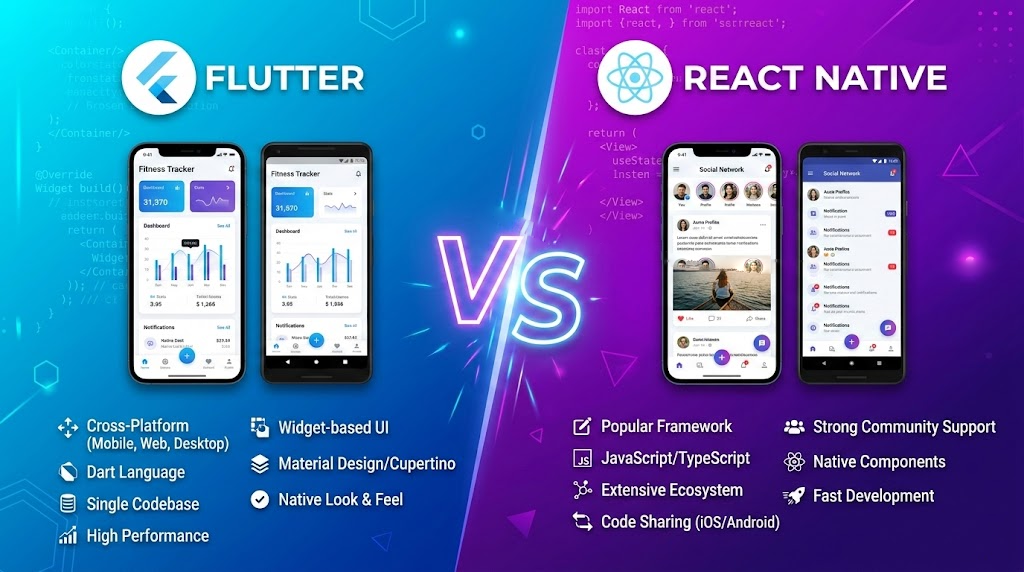
Introduction
You have decided to build a mobile app. You have done enough research to know that
building separate native apps for iOS and Android is expensive and time–consuming, so
cross–platform development makes sense. Now you are facing the question that every
business owner, product manager, and startup founder eventually hits: Flutter or React
Native?
It is one of the most searched technology questions in 2026 – and for good reason. The
cross–platform mobile development market has reached $25.6 billion this year, and
these two frameworks dominate it entirely. Flutter, backed by Google, holds
approximately 46% of the cross–platform market. React Native, backed by Meta
(Facebook), holds around 35%. Every other framework combined accounts for the rest.
The honest answer to the question is: it depends. But that answer is only useful if you
know what it depends on. This guide gives you the full picture – written for business
owners and decision–makers, not just developers – so you can walk into any
conversation with a development team fully informed and make the right call for your
specific situation.
What Are Flutter and React Native?
Both Flutter and React Native solve the same core problem: they let developers write
one codebase and deploy it as a native–quality app on both iOS and Android. Without
them, you would need two separate development teams writing two separate apps in
two different programming languages. Cross–platform frameworks cut that cost and
timeline roughly in half.
Flutter
instead of using the phone’s native UI components, Flutter draws every single pixel of
your app itself using its own rendering engine (called Impeller, which replaced the
earlier Skia engine). Think of it like a game engine for your app – total control over every
visual element, pixel–perfect consistency across every device.
Flutter can deploy not just to iOS and Android, but also to web, Windows, macOS, and
Linux from the same codebase – making it one of the most versatile cross–platform tools
available.
React Native
React Native is a mobile development framework built by Meta (Facebook) and
released in 2015. It uses JavaScript – the most widely used programming language in
the world – and takes a different approach: instead of drawing its own UI, it translates
your code into actual native components. A React Native button becomes a real iOS
UIButton or an Android Button – the same components Apple and Google use in their
own apps.
React Native has undergone a significant architectural transformation with its New
Architecture (including the Fabric renderer and TurboModules), which is now the default
for all new projects in 2026. This has resolved most of the performance limitations that
plagued older versions and closed the gap considerably with Flutter on speed and
responsiveness.
Flutter vs React Native: Head–to–Head Comparison
Let us go through the dimensions that actually matter for a business deciding between
these two frameworks.
Performance
Flutter has traditionally held the performance advantage, and that remains broadly true
in 2026 – though the gap has narrowed significantly. Flutter compiles Dart code ahead–of–time into native ARM or x64 machine code that runs directly on the device processor. Its Impeller rendering engine delivers consistent
60 to 120 frames per second even during complex animations, with pre–compiled
shaders that eliminate the rendering stutter that affected earlier versions. Under heavy
rendering loads, Flutter maintains smooth performance where React Native can
occasionally drop frames during complex animations. React Native’s New Architecture has addressed most historical performance concerns. The old JavaScript bridge – which was the bottleneck in earlier versions – has been replaced with JavaScript Interface (JSI) for direct, faster communication between the JavaScript layer and native modules. For standard business apps with lists, forms, navigation, and API calls, React Native now delivers consistently smooth 60fps performance that most users will not be able to distinguish from native.
Verdict: Flutter wins on raw performance, particularly for animation–heavy or graphics–
intensive apps. For standard business applications, both are excellent and the
difference is not meaningful to end users.
UI Quality and Visual Consistency
This is where the fundamental architectural difference between the two frameworks has the most practical impact for businesses.
Flutter draws every pixel itself, which means your app looks exactly the same on every iOS device, every Android device, every screen size, and every OS version. Pixel perfect brand consistency is guaranteed. If your brand guidelines require precise visual control – exact colors, exact animations, exact spacing – Flutter delivers this without compromise. It is also why Flutter is the preferred choice for highly branded consumer apps, financial interfaces, and anything where the visual experience is core to the product. React Native uses actual native platform components, which means your app looks and feels native on each platform – an iOS user gets iOS–style elements, an Android user gets Material Design elements. For many businesses, this is exactly what they want: an app that feels like it belongs on the device rather than like a cross–platform product. The trade–off is that achieving identical visuals across platforms requires additional work.
Verdict: Flutter wins for pixel–perfect brand consistency. React Native wins for apps that
should feel natively at home on each platform.
Development Speed
Both frameworks offer hot reload – the ability to see code changes reflected in the running app almost instantly, without restarting. This accelerates development significantly for both frameworks. For teams with existing JavaScript or React experience, React Native has a faster ramp–up. Developers already familiar with React can transition to React Native development quickly, and the vast npm ecosystem gives them access to hundreds of thousands of libraries that solve common problems. Flutter requires learning Dart, which is a lesser–known language. However, experienced developers find Dart straightforward to learn, and Flutter’s built–in widget library is so comprehensive that teams often need fewer third–party packages than in React Native, which can offset the learning curve. Flutter MVPs typically launch in 12 to 16 weeks, compared to 20 to 28 weeks for equivalent separate native app development.
Verdict: React Native wins for teams with JavaScript experience. Flutter wins for
greenfield projects with teams ready to invest in Dart.
Ecosystem and Third–Party Libraries
React Native’s biggest structural advantage is its ecosystem. JavaScript is used in 94.5% of websites, which means the npm package registry – with over 1.8 million packages – is available to React Native developers. Need Stripe payments, Auth0 authentication, Segment analytics, Firebase integration? The React Native ecosystem has battle–tested, well–maintained solutions for virtually every common requirement. Flutter’s package repository, pub.dev, now hosts over 45,000 packages – a number that has grown dramatically in recent years. Coverage of core use cases is strong, but for edge–case requirements or highly specialized integrations, React Native’s vastly larger ecosystem is still a practical advantage.
Verdict: React Native wins on ecosystem breadth. Flutter wins on reducing reliance on
third–party packages through its built–in widget library.
Developer Availability and Hiring
This is a practical consideration that significantly affects project cost and timeline that is often overlooked in technical comparisons. React Native developers are significantly more available than Flutter developers. Because React Native builds on JavaScript – the world’s most common programming language – the pool of developers who can work with it is much larger. React Native job postings on LinkedIn outnumber Flutter postings roughly 6 to 1 in Western markets. This means React Native projects are easier to staff and carry lower risk if a developer
needs to be replaced mid–project. Flutter developer availability is improving rapidly as the framework gains adoption, and in markets like India the talent pool is growing particularly fast. But for businesses in markets where Flutter developers are scarce, the hiring equation is a real consideration.
Verdict: React Native wins on developer availability globally. Flutter is increasingly
competitive in India and Southeast Asia.
Cost
Both frameworks reduce cost compared to native development by allowing a single codebase to serve both iOS and Android. The development cost difference between Flutter and React Native for a given project is usually driven by team availability andexperience rather than the framework itself. In Western markets, senior Flutter developers command slightly higher rates than React Native developers due to scarcity – average salaries run $135,000 to $180,000 annually for senior Flutter roles versus $125,000 to $160,000 for React Native. In India and similar markets, this premium is smaller or nonexistent. Long–term maintenance costs are an important consideration that is rarely discussed upfront. Flutter’s reduced reliance on third–party packages and its stable widget system tend to result in lower technical debt over time. React Native projects that accumulate dependencies can face maintenance complexity as those packages update at different
rates or introduce breaking changes.
Verdict: Similar initial cost. Flutter may have lower long–term maintenance cost for
complex apps.
Platform Coverage
Flutter has a broader platform story. In addition to iOS and Android, Flutter supports web, Windows, macOS, and Linux deployment from a single codebase. For businesses that want a single technology investment to cover mobile, desktop, and web,Flutter’s multi–platform capability is a significant advantage that React Native does not fully match. React Native is primarily a mobile framework. React Native for Web exists but is not as mature as Flutter’s web support. For businesses that need a comprehensive multi–platform strategy, Flutter offers a more unified path.
Verdict: Flutter wins on multi–platform coverage.
The Decision Framework: When to Choose Flutter
Choose Flutter when one or more of the following apply to your project:
• Your app requires a highly custom, branded UI: Pixel–perfect design fidelity across every device is non–negotiable. Your designers have specific visual requirements that must be implemented exactly as specified on both iOS and Android.
• Long–term maintainability is a priority:
The Decision Framework: When to Choose React Native
Choose React Native when one or more of the following apply to your project:
• Your team already knows JavaScript or React: The ramp–up advantage is real. If your web development team can transition to mobile work without learning a new language, you move faster and save on onboarding costs.
• Your app should feel natively at home on each platform: You want iOS users to get an iOS–feel app and Android users to get an Android–feel app, with platform–appropriate UI patterns and behaviors.
• You need deep native device integrations: Highly specific hardware access,
complex integrations with platform APIs, or functionality that relies heavily on platform–specific behavior tends to be more straightforward in React Native.
• Developer availability is a concern: You need to hire quickly or maintain the flexibility to replace developers mid–project. React Native’s larger developer pool gives you more options.
• Your app is primarily standard business functionality: Forms, lists, navigation, API calls, notifications, and data display. For these use cases React Native is perfectly capable and the performance difference compared to Flutter is negligible.
• You need to integrate with an existing React web ecosystem: Sharing code,components, or business logic between your web and mobile products is aconcrete efficiency advantage when using React Native alongside a React web app.
Real–
World Use Cases: Which Framework Fits Which App?
Sometimes the clearest way to understand the decision is through concrete examples.
Use Flutter for:
• A fintech app with a highly branded UI, smooth chart animations, and real–time data visualizations.
• A consumer lifestyle app (fitness, wellness, beauty) where visual identity and smooth animations drive engagement
• A product catalog or e–commerce app requiring pixel–perfect product presentation and fluid transitions
• Any app where the same codebase needs to run on mobile, tablet, web, and desktop
Use React Native for:
• A field service app for technicians that needs to feel native on both iOS and Android devices
• An internal business tool that connects to multiple enterprise systems via APIs
• A social or community platform that needs deep integration with device camera, contacts, and notifications
• A startup’s MVP that needs to reach market quickly with a JavaScript–fluent team
• Any app being built alongside a React web app where code sharing is a priority
What About Native Development? Is Cross–Platform Always the
Right Choice?
For most business applications in 2026, cross–platform development with either Flutter or React Native is the right choice. The performance gap between cross–platform and native has narrowed to the point where it is imperceptible to the average user in the vast-
majority of use cases. The cost and time savings of maintaining one codebase rather than two almost always outweigh the marginal performance benefits of native for typical business apps.Native development remains the better choice when: the app is highly performance critical and platform–specific (a mobile game with complex 3D graphics, for example), deep integration with cutting–edge platform features is required immediately on OS
release, or you are building a hardware–dependent application that relies on platform APIs that cross–platform frameworks have not yet abstracted well. For the overwhelming majority of business apps – booking systems, service platforms, customer portals, field tools, internal applications, e–commerce – Flutter or React Native is the smarter, more cost–effective path.
The Question Your Development Partner Should Be Asking You
If you ask a development company whether they recommend Flutter or React Native
and they answer immediately without asking you any questions – that is a red flag.
A good development partner should want to understand your project before recommending a framework. They should ask about your users and devices, your team’s existing skills, your timeline and budget, the visual complexity of your UI, your integration requirements, your long–term platform strategy, and whether you need web or desktop coverage in addition to mobile.
Nexuron Technologies: We Build in Both – and We Will Tell You Which One Fits
At Nexuron Technologies, we have development experience in both Flutter and React
Native. We do not have a preferred framework – we have a preferred outcome: the right technology for your specific project, delivered on time and built to last.
We have used Flutter to build cross–platform salon booking apps with real–time waiting times and rich, branded interfaces. We have used React Native to build service and field applications where native feel and fast delivery mattered most. And we have worked with businesses who came to us already committed to a framework – and
sometimes, where appropriate, we have had honest conversations about whether that was the right choice.
What we bring to every mobile development project is the same thing: a structured discovery process that clarifies requirements before a line of code is written, transparent communication throughout, milestone–based delivery, and full code ownership
transferred to you at the end.
The Final Verdict: There Is No Universal Winner
Flutter and React Native are both excellent, mature frameworks in 2026. The cross–
platform mobile development market is large enough and diverse enough that both will
thrive for the foreseeable future – and any development company that tells you one is
categorically better than the other without knowing your project is not giving you advice,
they are giving you a sales pitch.
Use this guide as your decision framework. Flutter if you need pixel–perfect UI
consistency, high–performance animations, or multi–platform deployment from one
codebase. React Native if your team knows JavaScript, your app needs a native feel on
each platform, or developer availability and ecosystem breadth are priorities.
Not sure whether Flutter or React Native is right for your app?
Nexuron Technologies builds cross–platform mobile apps in both Flutter and React Native for small and mid–sized businesses across India and internationally. Tell us about your project in a free 30–minute call and we will give you an honest recommendation – no commitment required.
Book your free consultation at nexurontechnologies.com