





















How Much Does an AI Chatbot Cost to Build for Your Business?
Artificial intelligence is changing how businesses communicate with customers, manage support requests, and automate everyday operations. AI chatbots are becoming an important tool for companies looking to improve customer experiences while reducing repetitive manual work.
However, one of the biggest questions businesses have before investing in this technology is: How much does it cost to build an AI chatbot for your business?
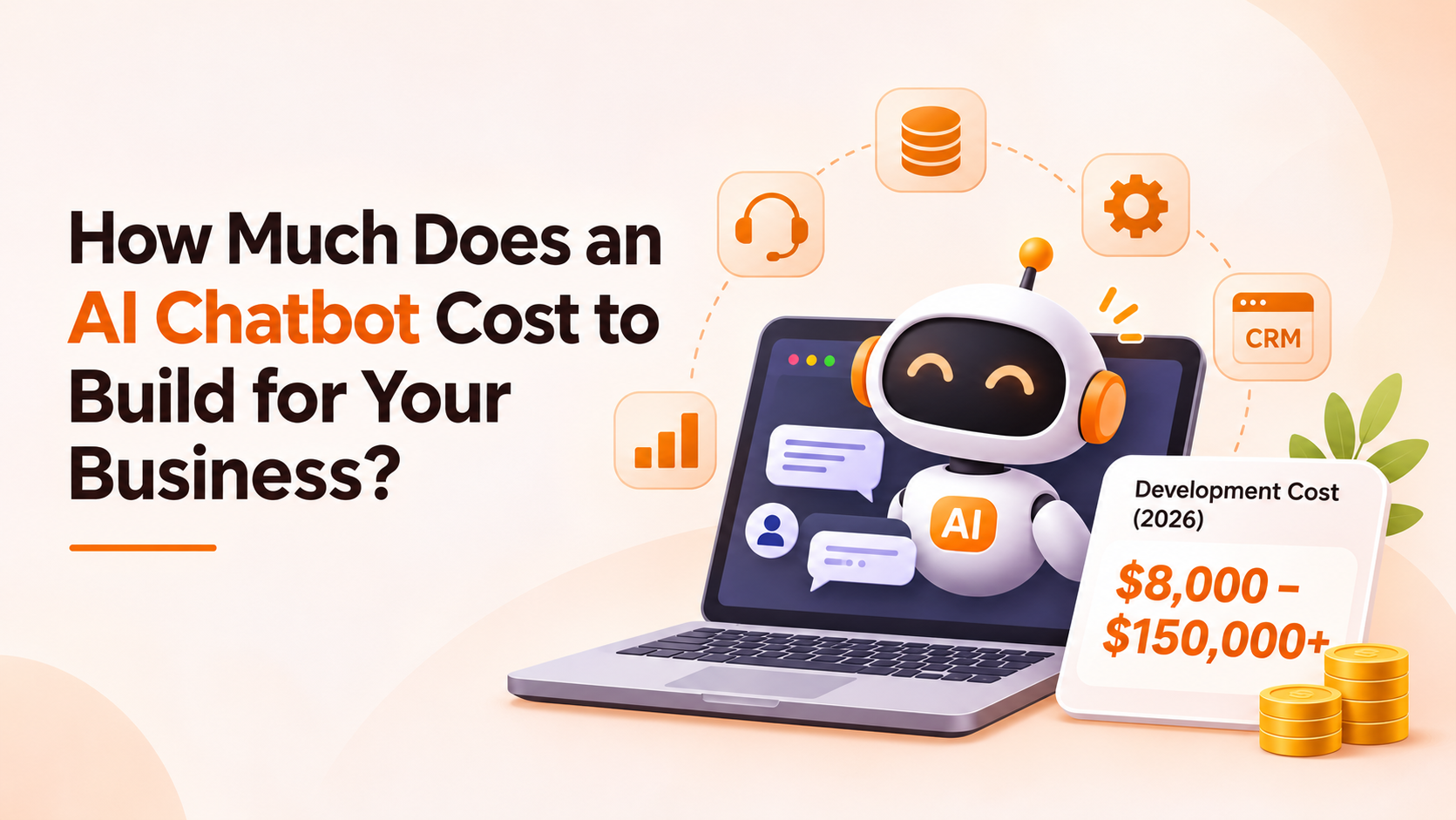
In 2026, AI chatbot development costs can range from a few thousand dollars for a basic solution to more than $150,000 for a sophisticated enterprise platform. The final investment depends on chatbot functionality, AI capabilities, integrations, security requirements, and expected usage.
In this guide, we will explore AI chatbot development costs, different chatbot types, important pricing factors, ongoing expenses, and ways to build an affordable solution for your business.
1. How Much Does It Cost to Build an AI Chatbot in 2026?
The cost of building an AI chatbot depends on the type of solution your business needs. A simple chatbot that answers frequently asked questions requires fewer resources than an advanced AI assistant connected to multiple business systems.
A custom AI chatbot can cost approximately $8,000 to $150,000 or more, depending on its functionality and complexity. More complex enterprise implementations may exceed this range.
| Chatbot Type | Estimated Development Cost | Estimated Timeline |
|---|---|---|
| Basic AI Chatbot | $8,000 to $20,000 | 4 to 8 weeks |
| Knowledge-Based AI Chatbot | $20,000 to $45,000 | 6 to 12 weeks |
| Business Integrated AI Chatbot | $35,000 to $80,000 | 10 to 18 weeks |
| AI Voice and Omnichannel Chatbot | $50,000 to $120,000 | 12 to 24 weeks |
| Enterprise AI Assistant | $80,000 to $150,000+ | 4 to 9 months |
These are indicative development estimates rather than fixed market prices. Actual costs depend on project scope, development teams, integrations, and deployment requirements.
2. Different Types of AI Chatbots and Their Costs
Not every business needs an advanced AI chatbot. Understanding the available options can help you choose a solution that matches your requirements and budget.
Basic FAQ Chatbot
A basic FAQ chatbot answers predefined questions and provides information about products, services, business hours, pricing, and general customer inquiries.
It is suitable for businesses that want to automate simple customer interactions without implementing complex AI capabilities.
- Frequently asked questions
- Basic customer support
- Website chat integration
- Predefined conversation flows
- Basic lead collection
AI-Powered Chatbot
An AI-powered chatbot uses large language models (LLMs) and natural language processing to understand customer questions and generate relevant responses.
Unlike traditional chatbots, it can understand different ways of asking the same question and provide more natural conversations.
- Natural language understanding
- Context-aware conversations
- Personalized responses
- Automated customer assistance
- Conversation history
Knowledge-Based AI Chatbot
A knowledge-based chatbot uses your company's information, documents, FAQs, product catalogs, and internal resources to answer questions.
Retrieval-Augmented Generation (RAG) allows the chatbot to retrieve relevant information from your knowledge base before generating an answer.
- Answers based on company documents
- Internal knowledge search
- Product and service information
- Document-based question answering
- Knowledge base management
Business Integrated AI Chatbot
A business-integrated chatbot connects with existing software and helps customers or employees complete specific tasks.
For example, an AI chatbot can connect with a CRM system to retrieve customer information, create support tickets, check order status, or manage appointments.
- CRM and ERP integrations
- Customer account management
- Appointment scheduling
- Payment and order tracking
- Automated business workflows
Enterprise AI Assistant
Enterprise AI assistants are designed for organizations with complex workflows, large datasets, and multiple departments.
They can connect with different business applications, support multiple communication channels, and handle advanced requests with appropriate security controls.
- Advanced AI automation
- Multiple system integrations
- Enterprise-level security
- Multilingual conversations
- Advanced analytics and reporting
- Scalable infrastructure
3. Ready-Made AI Chatbot vs Custom AI Chatbot
Before investing in chatbot development, businesses should decide whether to purchase an existing chatbot platform or build a custom solution.
Both approaches have advantages, depending on business requirements and long-term plans.
| Comparison | Ready-Made Chatbot | Custom AI Chatbot |
|---|---|---|
| Initial Cost | Generally lower | Generally higher |
| Development Time | Faster setup | Requires development |
| Customization | Limited by platform | Designed around business needs |
| Integrations | Depends on available connectors | Can support custom integrations |
| Scalability | Depends on subscription and platform limits | Can be designed for specific growth requirements |
| Maintenance | Mostly managed by provider | Requires ongoing technical support |
| Ownership | Platform-dependent | Depends on the development agreement |
Ready-made platforms are often suitable for businesses that need basic customer support automation. Custom development is more appropriate when the chatbot needs specialized functionality, access to private business data, or deeper integration with existing systems.
4. What Factors Affect AI Chatbot Development Costs?
Several technical and business requirements influence the overall cost of developing an AI chatbot.
AI Model Selection
The AI model determines how the chatbot understands questions and generates responses. Different models have different capabilities, pricing structures, and performance requirements.
Choosing the right model depends on response quality, speed, expected usage, and the complexity of customer interactions.
Chatbot Features and Functionality
The number and complexity of features directly affect development effort.
Basic question answering requires less development than an AI assistant that processes transactions, manages customer accounts, or performs automated workflows.
Data Preparation and Training
AI chatbots often need access to business documents, product information, customer support articles, and internal knowledge bases.
Preparing, organizing, cleaning, and connecting this information requires additional technical work.
Third-Party Integrations
Integrations allow chatbots to communicate with external applications and perform useful business operations.
Common integrations include:
- CRM platforms
- Payment gateways
- Customer support systems
- WhatsApp and messaging platforms
- Appointment booking systems
- Business databases and APIs
UI/UX Design
A chatbot should be easy to use and accessible across different devices. Custom chat interfaces, conversation layouts, interactive elements, and responsive design can increase development costs.
Security and Privacy
Businesses handling customer information must consider data protection, access permissions, encryption, secure API connections, and applicable compliance requirements.
Development Team
The cost also depends on the expertise and location of the development team. Experienced AI engineers, backend developers, UI/UX designers, and QA specialists may be required for more complex projects.
5. Monthly Operating Costs of an AI Chatbot
Building an AI chatbot is only part of the investment. Businesses must also consider the expenses required to operate and maintain it after deployment.
| Expense Category | What It Includes |
|---|---|
| AI Model API | Input and output token usage |
| Cloud Hosting | Servers, databases, and infrastructure |
| Monitoring | Performance tracking and error monitoring |
| Maintenance | Bug fixes, updates, and improvements |
| Third-Party Services | External API subscriptions and messaging fees |
| Knowledge Base Updates | Updating business information and documents |
Monthly expenses can range from a few hundred dollars to several thousand dollars, depending on conversation volume, AI model selection, infrastructure, and support requirements.
Businesses should estimate operating costs using expected monthly conversations and average token consumption rather than relying only on the initial development quote.
6. How Long Does It Take to Build an AI Chatbot?
The development timeline depends on chatbot complexity, data availability, integrations, testing requirements, and the size of the development team.
A typical AI chatbot development process includes the following stages:
| Development Stage | Main Activities |
|---|---|
| Planning and Research | Understanding business requirements and defining chatbot functionality |
| UI/UX Design | Designing the chatbot interface and conversation experience |
| AI Integration | Connecting AI models and configuring conversation logic |
| Backend Development | Building APIs, databases, and business integrations |
| Testing and QA | Testing response accuracy, security, and performance |
| Deployment | Launching the chatbot and configuring production infrastructure |
| Maintenance | Monitoring conversations and improving chatbot performance |
Defining the project scope and preparing business data before development begins can help reduce delays and unnecessary development work.
7. How to Reduce AI Chatbot Development Costs
Building an AI chatbot does not always require a large initial investment. Businesses can control development expenses by choosing the right features and implementation strategy.
Start with a Specific Use Case
Instead of building a chatbot that handles every business operation, start with one specific problem, such as customer support, lead generation, or appointment scheduling.
Build an MVP First
A Minimum Viable Product (MVP) includes only the essential chatbot features needed for the first release. Additional functionality can be introduced after collecting feedback and understanding user requirements.
Choose the Right AI Model
Not every conversation requires the most advanced AI model. Use models that match the complexity of the task and consider smaller, more economical models for simpler requests.
Reuse Existing Business Data
Organize existing FAQs, product documentation, support articles, and internal resources before development. This can reduce the time required to prepare a chatbot's knowledge base.
Prioritize Important Integrations
Start with essential integrations rather than connecting every business application immediately. Additional integrations can be introduced as chatbot requirements grow.
Monitor AI Usage
Track API consumption, conversation volume, response length, and infrastructure usage. Regular monitoring helps identify unnecessary expenses and optimize operating costs.
8. Benefits of Building an AI Chatbot for Your Business
An AI chatbot can provide several operational benefits when implemented around the right business requirements.
- 24/7 Customer Support: Respond to common customer questions even outside regular business hours.
- Reduced Manual Work: Automate repetitive conversations and routine support requests.
- Faster Responses: Help customers find information without waiting for a support representative.
- Lead Generation: Collect customer details and identify potential business opportunities.
- Improved Customer Experience: Provide consistent and relevant assistance across communication channels.
- Business Scalability: Handle increasing conversation volumes without requiring a proportional increase in support staff.
- Business Insights: Analyze conversation data to identify common questions and customer needs.
9. When Should Your Business Invest in a Custom AI Chatbot?
A custom AI chatbot can be useful when existing tools cannot properly support your business requirements.
Consider custom development if your business:
- Receives a high volume of repetitive customer inquiries.
- Needs chatbot responses based on private company documents.
- Requires integration with existing business applications.
- Wants to automate specific internal workflows.
- Needs greater control over chatbot functionality and data handling.
- Plans to expand AI-powered services as the business grows.
However, custom development is not always the most economical option. If a ready-made chatbot platform already meets your requirements, starting with an existing solution may provide better value.
10. Frequently Asked Questions
How much does it cost to build an AI chatbot for a business in 2026?
A custom AI chatbot can cost approximately $8,000 to $150,000 or more, depending on complexity, integrations, AI capabilities, and security requirements. Basic solutions cost less, while enterprise implementations require larger investments.
Can I build an AI chatbot for less than $10,000?
Yes. A basic chatbot or a small proof of concept can be developed for less than $10,000, especially when using existing AI models and chatbot platforms. However, complex integrations and production requirements may increase the budget.
How much does it cost to maintain an AI chatbot?
Maintenance costs depend on infrastructure, AI usage, conversation volume, monitoring, and technical support. Businesses should also account for API usage and third-party service fees.
What is the difference between an AI chatbot and a traditional chatbot?
A traditional chatbot generally follows predefined rules and conversation flows. An AI chatbot uses technologies such as natural language processing and large language models to understand questions and generate more flexible responses.
How long does it take to develop an AI chatbot?
A basic chatbot may take a few weeks, while a custom business chatbot with knowledge base functionality and integrations can take several months. Enterprise solutions may require even longer development timelines.
Can an AI chatbot integrate with my existing CRM?
Yes. A custom AI chatbot can integrate with CRM platforms through APIs and supported connectors. It can retrieve customer information, create leads, update records, and automate selected workflows.
Is a custom AI chatbot better than a subscription-based chatbot?
It depends on your requirements. Subscription-based chatbots are often suitable for basic customer support, while custom solutions provide greater flexibility for specialized workflows, private business data, and advanced integrations.
Conclusion
The cost of building an AI chatbot for your business in 2026 depends on its functionality, AI model, integrations, security requirements, and expected usage.
A basic chatbot can be a cost-effective starting point, while an advanced AI assistant may require a significantly larger investment. Businesses should evaluate both initial development expenses and ongoing operating costs before choosing a solution.
Start with clearly defined business requirements, prioritize essential features, and choose an AI solution that can grow alongside your organization.
Planning to build an AI chatbot for your business? Work with an experienced development team to identify the right approach, estimate your project requirements, and create an AI-powered solution that supports your business goals.
Sources and References
Tagged in
Written by
Arsh