



























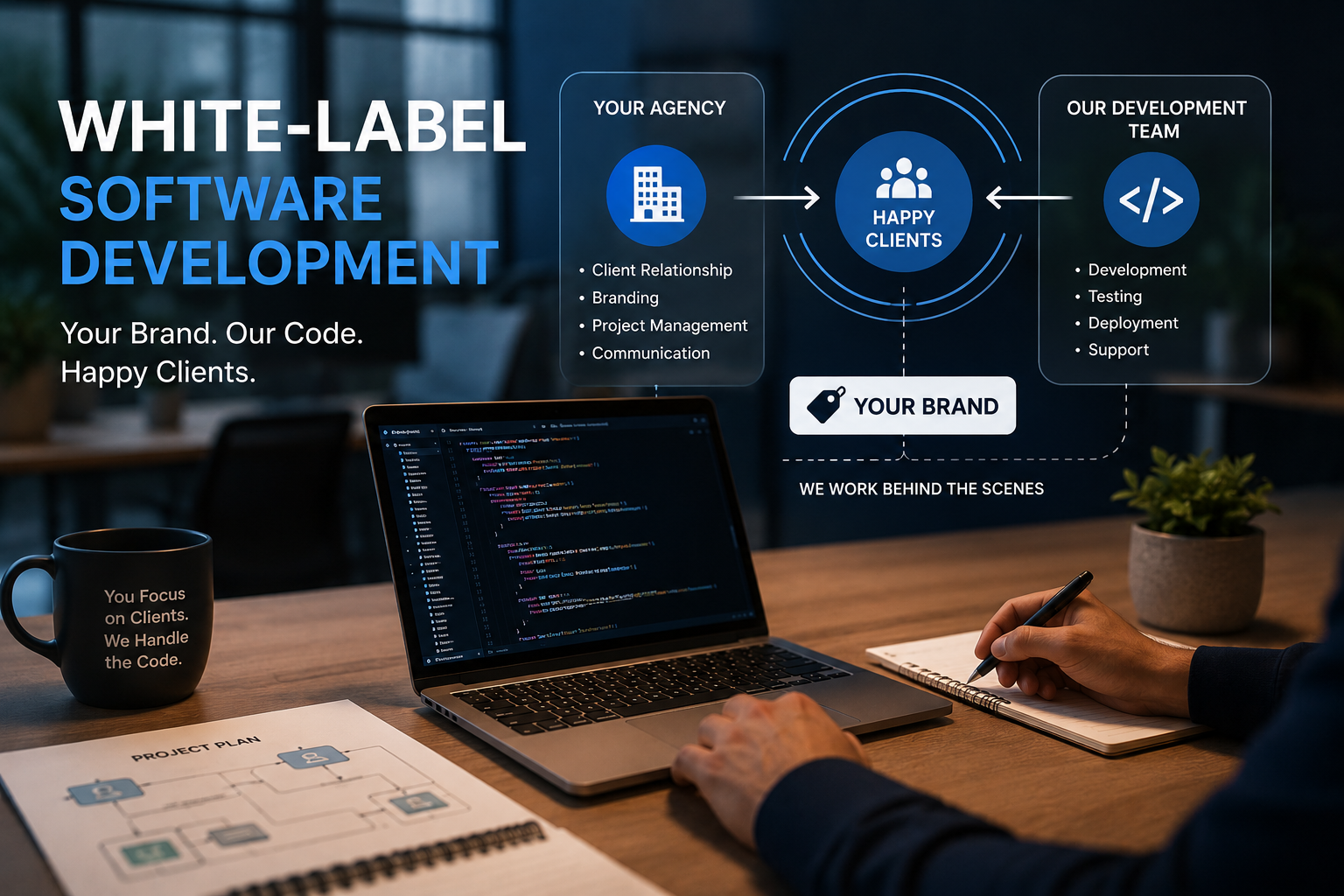
What Is White-Label Software Development?
White-label software development is a business model where a software development company builds websites, applications, SaaS platforms, or custom software on behalf of another company, while the other company presents the finished product to its client under its own brand.
In simple terms:
Your agency manages the client. Your development partner handles the technology behind the scenes.
This allows digital agencies, marketing agencies, consultants, and other businesses to offer software development services without building and maintaining a large in-house development team.
For example, a digital agency may have a client who needs a custom web application. Instead of hiring several developers, the agency can work with a white-label software development partner to handle the technical development.
The agency remains responsible for the client relationship, while the development partner works behind the scenes.
How Does White-Label Software Development Work?
A typical white-label development partnership looks like this:
Client
↓
Digital / Marketing Agency
↓
White-Label Development Partner
The client communicates with the agency, and the agency manages the overall relationship.
The development partner handles the technical work according to the agency's requirements.
Depending on the agreement, the development partner may provide:
- UI/UX development
- Website development
- Web application development
- Mobile app development
- SaaS development
- Backend development
- API integrations
- Cloud development
- QA and testing
- Maintenance and support
The final product is delivered to the agency, which presents it to its client under its own brand.
Why Are Agencies Using White-Label Development?
Digital agencies often face a common problem: their clients need more technical services than the agency can provide internally.
An agency may be excellent at:
- Digital marketing
- SEO
- Branding
- UI/UX design
- Content marketing
- Advertising
But its clients may also need:
- Custom software
- Websites
- Mobile applications
- SaaS platforms
- API integrations
- AI solutions
Hiring a full development team for every new service isn't always practical.
White-label development gives agencies another option.
Instead of turning down a project or hiring additional employees, they can work with a trusted development partner.
7 Benefits of White-Label Software Development
1. Expand Your Service Offering
One of the biggest advantages is the ability to offer additional technical services.
For example, a marketing agency can start offering:
- Website development
- Custom software
- Mobile applications
- SaaS development
without needing to build a large development department internally.
This can help agencies become a more complete technology partner for their clients.
2. Take on More Projects
Agencies don't always have a consistent workload.
One month, an agency may have more projects than its internal team can handle. Another month, demand may be lower.
A white-label development partner provides additional capacity when required.
Instead of saying:
"We don't have enough developers for this project."
the agency can bring in its development partner.
3. Reduce Hiring Pressure
Building an internal development team requires more than hiring developers.
There can also be costs associated with:
- Recruitment
- Salaries
- Benefits
- Training
- Management
- Equipment
- Software
- Retention
Working with an external development partner can provide access to technical expertise without requiring the agency to build the entire team internally.
4. Maintain the Client Relationship
One of the most important aspects of white-label development is that the agency can remain the primary client-facing company.
The agency manages:
- Client communication
- Project strategy
- Branding
- Account management
- Business requirements
The development partner focuses on delivering the technical work.
This creates a clear division of responsibilities.
5. Access a Wider Range of Technical Skills
A good development partner may have developers with experience across different technologies and project types.
For example:
- React
- Next.js
- Node.js
- .NET
- Python
- PHP
- Flutter
- React Native
- AWS
- Azure
- APIs
- AI integrations
- Databases
This can make it easier for agencies to take on projects requiring skills they don't currently have in-house.
6. Improve Project Scalability
Suppose an agency normally has three developers.
A new client suddenly requires a large SaaS application.
Hiring five additional developers immediately may not make business sense.
Instead, the agency can use a development partner to increase its delivery capacity for that project.
This creates a more flexible model for scaling.
7. Build Long-Term Partnerships
White-label development doesn't have to be limited to one project.
The strongest partnerships are often ongoing.
Agency → Development Partner
Project 1 → Website
Project 2 → Mobile App
Project 3 → SaaS Platform
Project 4 → Maintenance
Project 5 → New Client Project
Over time, the development company becomes an extension of the agency's team.
White-Label Development vs Traditional Outsourcing
White-label development and outsourcing can look similar, but there is an important difference.
With traditional outsourcing, the client may know which external company is performing the development.
With white-label development, the development company typically operates behind the agency's brand.
| White-Label Development | Traditional Outsourcing |
|---|---|
| Agency remains client-facing | Outsourcing company may be client-facing |
| Development happens behind the scenes | External company may communicate directly with client |
| Work can be delivered under agency branding | External company's identity may be visible |
| Designed for agency partnerships | Can be used by many types of businesses |
| Often focused on long-term partnerships | Often project-based |
The right model depends on how the business relationship is structured.
How to Choose a White-Label Development Partner
Choosing the right development partner is extremely important.
The cheapest provider isn't necessarily the best option.
Here are several things agencies should consider.
Technical Expertise
Make sure the development company has experience with the technologies required for your projects.
Ask for relevant examples rather than simply looking at a list of technologies.
Communication
Communication can make or break a development partnership.
Ask:
- How frequently will we receive updates?
- Who will manage the project?
- How quickly does the team respond?
- Which communication tools do you use?
Quality Assurance
A development partner should have a clear QA and testing process.
You don't want your agency team to discover major technical problems after delivery.
Security and Confidentiality
White-label partnerships often involve sensitive business information and client data.
Before starting a partnership, agencies should consider:
- NDAs
- Access controls
- Data protection
- Code ownership
- Intellectual property
- Security procedures
Scalability
Ask whether the partner can support you when your workload increases.
A good partner should be able to provide additional development capacity when needed.
Transparent Pricing
Make sure you understand how development work is priced.
Common models include:
- Fixed-price projects
- Hourly development
- Dedicated developers
- Monthly development teams
The best model depends on the project and the agency's requirements.
How Much Does White-Label Software Development Cost?
There isn't one fixed price for white-label development.
The cost depends on factors such as:
- Project complexity
- Number of developers
- Technology stack
- Project duration
- UI/UX requirements
- Integrations
- Backend complexity
- Testing requirements
- Maintenance requirements
A simple website may require a relatively small development budget, while a custom SaaS platform can require a much larger investment.
For this reason, agencies should evaluate development partners based on quality, reliability, communication, and long-term value, rather than choosing purely on hourly rates.
When Should an Agency Consider White-Label Development?
White-label development can be a good option when:
- Your agency is receiving more projects than your team can handle.
- Clients are asking for technical services you don't currently provide.
- You don't want to hire a large development team.
- You need access to specialised technical skills.
- You want to expand your service offering.
- You want a reliable development team for ongoing projects.
- You want to take on larger projects without significantly increasing internal headcount.
How to Build a Successful White-Label Partnership
A successful partnership requires more than simply hiring developers.
Both companies should establish clear processes from the beginning.
1. Define Responsibilities
Decide who handles:
- Client communication
- Project management
- Requirements
- Development
- Testing
- Deployment
- Support
2. Establish Communication Processes
Define:
- Meeting schedules
- Reporting
- Project management tools
- Response times
- Escalation procedures
3. Start with a Small Project
Before committing to a long-term partnership, consider starting with a smaller project.
This allows both companies to evaluate:
- Communication
- Development quality
- Reliability
- Delivery timelines
- Collaboration
4. Create a Repeatable Process
Once the partnership works well, establish a standard process for onboarding and delivering new projects.
This makes it easier to scale the relationship.
Why White-Label Development Can Be a Win-Win for Agencies
The agency gets additional development capacity.
The development company gets access to recurring projects.
The client receives a complete solution.
Everyone benefits when the partnership is structured correctly.
The key is to build a relationship based on trust, communication, quality, and consistent delivery.
Final Thoughts
White-label software development allows digital agencies and other service companies to expand their technical capabilities without building an entire development team internally.
Instead of turning away development opportunities, agencies can partner with an experienced development company and provide additional services under their own brand.
The right white-label development partner can become more than just an external vendor.
They can become an extension of your agency's technical team.
If your agency regularly receives website, application, SaaS, or custom software opportunities, a reliable white-label development partnership can give you the additional capacity needed to take on those projects while keeping your focus on your clients and your core business.
Looking for a White-Label Development Partner?
If your agency needs a reliable development team behind the scenes, [Your Company Name] can help with web development, mobile applications, SaaS, custom software, and other technology projects.
[Talk to our development team →]
Tagged in
Written by

Umesh Patel